
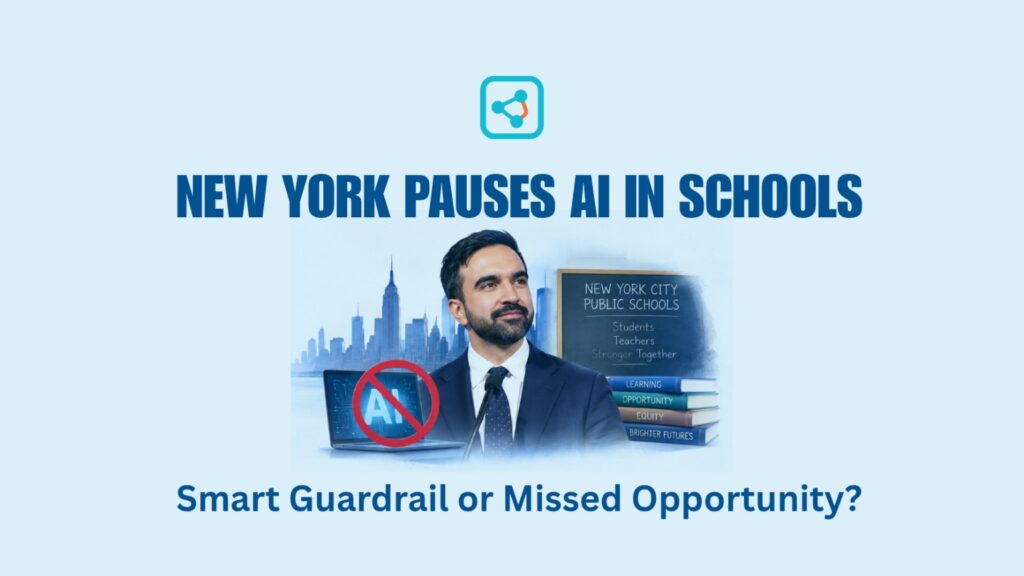
Quick answer: New York City is not banning all AI from education. For the 2026–27 school year, the city is imposing a one-year moratorium on student-facing generative AI for grades 2-K through 8, while allowing tightly controlled high-school pilots, AI literacy instruction, teacher use for planning and operational work, and exceptions for assistive technology and certain career-readiness programs.
New York City has become one of the highest-profile test cases in the debate over how schools should handle generative AI.
On September 2, 2026, Mayor Zohran Mamdani and Schools Chancellor Kamar Samuels announced what the city describes as the country’s broadest student-facing generative AI moratorium. The policy affects nearly 600,000 students in grades 2-K through 8 and will run for one school year while the city studies the impact of AI on learning, development and classroom life. NYC Mayor’s Office
The policy is more nuanced than the headline “New York bans AI in schools.” High-school students will still receive twice-yearly AI literacy modules, and up to 50,000 students may participate in limited, teacher-supervised pilots using vetted AI tools. Companion-style AI chatbots are prohibited across all grades. Teachers can continue using approved AI for lesson planning and operational tasks, but not as a replacement for student-teacher interaction. NYC Public Schools guidance
Why New York City is taking a cautious approach
The administration’s central argument is developmental rather than anti-technology. Mamdani has said younger students need time to build independent thinking, social skills and relationships with teachers before they routinely outsource parts of the learning process to AI.
That concern is not without evidence. The OECD’s 2026 Digital Education Outlook concludes that general-purpose generative AI can improve task performance without necessarily improving learning. When students offload too much cognitive work, the result can be disengagement or weaker long-term skill development. At the same time, the OECD also finds that AI can support learning when it is used with clear pedagogical goals and structured teacher guidance. OECD Digital Education Outlook 2026
A 2026 scoping review of K–12 research also identified potential risks including dependency, anxiety, social isolation, reduced authorship and what some researchers describe as “cognitive debt.” The authors recommend scaffolded use, AI literacy and teacher professional development rather than uncontrolled adoption. Computers and Education: Artificial Intelligence
The strongest arguments for and against the moratorium
| Potential benefits | Potential drawbacks |
|---|---|
| Protects younger students from becoming dependent on AI before core reading, writing, reasoning and problem-solving skills are established. | Students may lose opportunities to learn how to use AI responsibly at the age when digital habits are forming. |
| Gives the school system time to evaluate safety, privacy, bias and educational value before scaling tools across hundreds of thousands of children. | A broad moratorium can treat very different AI tools as if they carry the same educational risk. |
| Preserves teacher-student interaction and keeps human instruction at the center of younger students’ education. | Teachers may face a widening gap between what students encounter outside school and what they are permitted to use inside the classroom. |
| Creates pressure on vendors to demonstrate learning value, safety and data transparency. | Schools that move too slowly may leave students less prepared for universities and workplaces where AI use is becoming normal. |
| Reduces opportunities for shortcutting assignments, plagiarism and uncritical acceptance of AI-generated answers. | Prohibition does not necessarily teach good judgment. Students may still use AI at home without guidance from teachers. |
The case for the ban: build thinking skills before outsourcing them
The strongest argument for New York’s policy is that schools should be cautious about introducing a tool whose central value is making cognitive work easier.
For adults, that can be productive. For a child still learning how to write an argument, solve a problem or research a topic, the same convenience can interfere with the process the assignment is designed to develop.
The OECD draws an important distinction here: performing better with AI is not automatically the same as learning more. That is especially relevant in elementary and middle school, where the process of struggling through a task may be part of the educational value.
The city is also responding to concerns that AI had already been embedded into educational software without sufficient parent awareness or consistent oversight. The new policy says more than 38 previously allowed AI-enabled programs will have their AI components discontinued or disabled if they do not meet the new standards. NYC Mayor’s Office transcript
The case against the ban: AI literacy should start before high school
The strongest counterargument is that AI is not going away, and the ability to question, verify and use it responsibly may become a basic form of literacy.
The OECD and European Commission’s 2026 AI Literacy Framework argues that primary and secondary education should prepare learners to understand how AI works, critically evaluate its output and use it ethically and creatively. AI Literacy Framework
That does not necessarily mean giving an eight-year-old unrestricted access to a chatbot. But critics of broad bans can reasonably argue that guided exposure is different from uncontrolled use.
A carefully designed classroom tool might ask a student to challenge an AI answer, compare it with a textbook, identify bias or explain why the model is wrong. Used that way, AI becomes the object of critical thinking rather than a substitute for it.
The risk of waiting until ninth grade is that many students will already have encountered AI informally through search, social media, homework tools and family devices. If schools avoid the topic entirely for younger students, the most influential AI education may happen outside school and without teacher guidance.
New York’s policy is really a controlled experiment
One reason the policy deserves a more balanced reading is that it is temporary.
The city is creating a Technology in Schools Coalition made up of students, educators, parents, elected officials, advocates, unions and experts. The group is expected to study the moratorium and high-school pilots and make recommendations for future school years.
High-school students are not being placed in an AI-free environment. They will receive two 45-minute AI literacy modules each year, and limited pilots will test vetted tools under teacher supervision. The pilots are intended to have defined learning goals.
That makes the policy less a permanent rejection of AI and more a decision to slow deployment while collecting evidence.
A sensible middle ground may be age-based and task-based
The debate is often framed as ban AI versus embrace AI, but education probably needs a more granular model.
- Younger students: minimal or no generative AI for core skill-building tasks.
- Older students: supervised AI literacy and carefully selected educational tools.
- Research and writing: require students to show sources, reasoning and revision history rather than only the final answer.
- Teachers: allow AI for planning and administration while keeping grading and high-stakes judgment human-led.
- Accessibility: preserve exceptions where AI materially supports students with disabilities or language needs.
- Vendors: require transparent data practices and evidence that the product improves learning rather than simply increasing engagement.
What this debate means beyond New York
New York City Public Schools is the largest school system in the United States. Its policies tend to attract attention far beyond the five boroughs.
Caribbean education systems will eventually face many of the same questions. Students already have access to ChatGPT-style tools outside school. Teachers are experimenting with AI for lesson preparation. Governments and private schools will have to decide where AI helps learning, where it undermines it and what safeguards should be expected from vendors.
The lesson from New York should not necessarily be “ban AI.” It may be that education leaders should avoid adopting AI simply because vendors have added it to a platform.
Questions education leaders should ask
- What learning outcome is this AI tool supposed to improve?
- Is the student still doing the thinking?
- What happens to the student’s data?
- Can the teacher understand and control what the AI is doing?
- Is there evidence that the tool improves learning, not just task completion?
- At what age is this use appropriate?
Where I land
New York’s one-year moratorium is defensible as a pause, particularly for younger children, because the evidence base is still developing and schools should be careful about outsourcing core cognitive work.
But a long-term policy that simply keeps students away from AI would be difficult to justify. The technology is becoming part of work, search, communication and everyday software. Schools will eventually need to teach students how to question AI, verify it and use it without becoming dependent on it.
The strongest version of New York’s approach would therefore be protect first, study carefully, then introduce AI deliberately where there is evidence that it supports learning.
For businesses, schools and governments alike, that is a useful principle: AI adoption should start with a defined outcome, appropriate guardrails and a clear understanding of where human judgment still matters.