
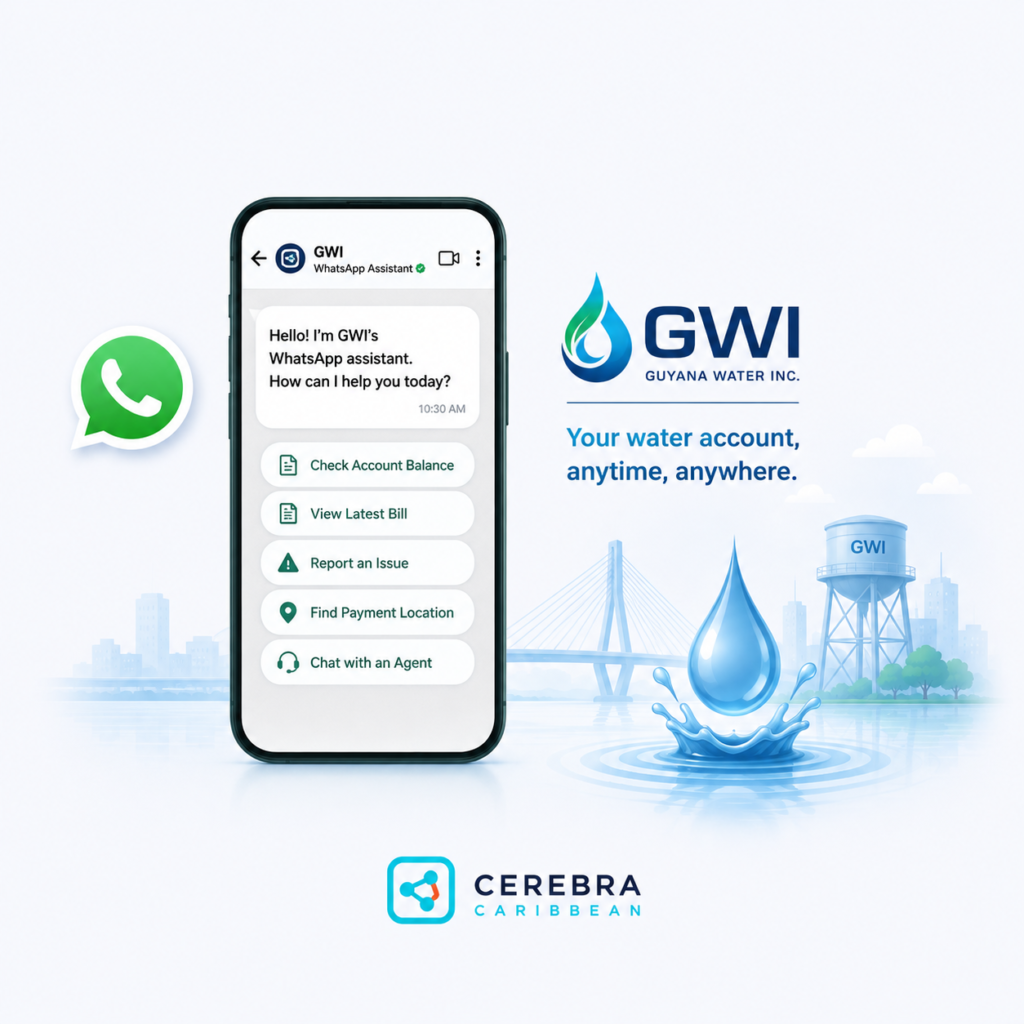
When Guyana Water Inc. (GWI) unveiled its WhatsApp Chatbot at the utility’s Corporate Complex on Vlissengen Road in January 2024, the moment carried a symbolism that went beyond a single state enterprise updating its customer service channel. Here was a public utility — the kind of institution Caribbean consumers associate with long lines, static hold music, and forms filled out in triplicate — choosing to meet its customers on the one platform nearly every Guyanese already has open on their phone. For business leaders across the region watching a state-run water company make this move before many private enterprises did, GWI’s rollout offers a working case study in how to bring AI-driven service to a Caribbean customer base, and what still has to be built around the technology to make it stick.
A Utility Meets Its Customers Where They Already Are
The numbers behind GWI’s decision are unremarkable in isolation but telling in aggregate. WhatsApp’s penetration across Caribbean markets runs well above 80 percent in many countries, and regionally, the app functions less like a messaging tool and more like commercial infrastructure — the default channel through which consumers expect to reach a business, check a balance, or resolve a problem.
Rather than building a standalone app that customers would need to discover, download, and remember to open, the utility built its digital front door on a platform its customers had already adopted for everything else in their lives.
Getting into the chatbot required only that customers save a dedicated GWI mobile number to their contacts or scan a QR code at a service point. From there, a short one-time registration collected a customer’s name, address, and email before handing them a menu of the utility’s available services. For Caribbean businesses evaluating their own AI customer service investments, this is the first and arguably most transferable lesson: the channel matters as much as the technology itself.
What the Chatbot Actually Does
GWI’s WhatsApp Chatbot gives customers round-the-clock access to core account services, backed by a live-chat feature that lets a customer escalate to a human agent whenever the automated system reaches the edge of what it can responsibly handle. Once registered, customers can check their account balance, view their most recent bill, locate an authorized payment agency, and submit a report or a service query — the small set of high-frequency, low-complexity transactions that, in most service businesses, generate a disproportionate share of call-center volume.
Andrea Khan, GWI’s Director of Commercial and Customer Services Relations, framed the tool at its launch as central to making the utility’s service more efficient, equitable, and customer-centric. The chatbot came out of a collaboration between the utility’s Customer Service and ICT teams and external technology partner Cassini Technologies (Castech).
That partnership structure matters for any Caribbean business sizing up a similar project. GWI did not attempt to build conversational AI in-house from a standing start, nor did it fully outsource the work and hope the result matched its customers’ needs. It combined internal domain knowledge with an external partner capable of building and deploying the conversational infrastructure.
The Long Runway From Soft Launch to Public Rollout
One of the more instructive aspects of GWI’s rollout is how patient it was. The chatbot was quietly soft-launched at GuyExpo the previous year, well before its formal public introduction, and by the time of the January 2024 launch it had already accumulated some 1,250 users. That’s a modest number for a utility serving hundreds of thousands of households nationwide, and it reflects a deliberate, staged approach rather than a single flip-the-switch announcement.
This matters because AI customer service tools live or die on the quality of the conversations they’re trained to handle, and that quality only becomes visible once real customers with real, messy questions start using the system. A soft launch gave GWI a runway to observe where customers struggled and where the handoff to a live agent needed tightening before scaling exposure.
Why a Utility Went First — And What That Means for Everyone Else
Public utilities across the Caribbean are not typically first movers on customer experience technology; competitive pressure usually drives that kind of investment in the private sector. GWI’s customers have no alternative water provider — and yet the utility invested in a WhatsApp assistant anyway, framing it explicitly around service equity rather than competitive necessity.
That framing should reorient how Caribbean business owners think about AI customer service — not primarily as a cost-cutting measure, though it can reduce repetitive workload, but as an accessibility investment. A WhatsApp assistant available outside normal office hours serves customers who cannot conveniently call or visit during the day. A live-chat escalation path serves the customer whose issue genuinely requires human judgment.
The Regional Context GWI’s Move Sits Inside
GWI’s chatbot did not emerge in a vacuum. Caribbean adoption of AI and automation in customer-facing roles has accelerated as businesses respond to the same WhatsApp-centric consumer behaviour that shaped GWI’s platform choice.
The important strategic point is less about any one technology forecast and more about customer behaviour: messaging has become a primary interface between many Caribbean businesses and the people they serve. That makes WhatsApp automation a customer-experience decision, not simply an IT project.
What Caribbean Businesses Should Take From This
Build on the channel your customers already use, not the one that’s easiest for you to build. GWI’s choice of WhatsApp over a proprietary app or portal removed a major barrier to adoption: getting customers to show up in the first place.
Keep a human escalation path visible and functional, not decorative. The live-chat handoff wasn’t an afterthought bolted onto GWI’s chatbot — it was presented as a core feature from day one.
Treat launch as a process, not an event. The gap between GWI’s soft launch and its formal public rollout gave the utility space to learn from real usage before scaling exposure.
Partner deliberately rather than build alone. GWI paired its own customer service and ICT expertise with an external technology partner rather than attempting to develop the system entirely in-house or outsourcing it without internal input.
What GWI’s WhatsApp Strategy Means for Guyanese Businesses
GWI’s rollout gives Guyanese companies a useful local benchmark. Customers do not need to be persuaded to adopt another app before a business can improve digital service; the more practical route may be to make an existing WhatsApp conversation substantially more capable.
For a retailer, distributor, dealership, clinic or service company, that can mean answering repetitive questions immediately, retrieving approved information, capturing the customer’s requirement and escalating to staff with context intact. The same principle becomes more powerful when the conversational layer can connect to inventory, CRM, booking or other operational systems.
For more on the local market, see our AI automation solutions for businesses in Guyana and our guide to WhatsApp AI for Guyanese distributors.
Want to see what this model could look like on your own WhatsApp channel?
Book a 15-minute AI agent demo → and we’ll walk through a real customer-service workflow based on your business.