
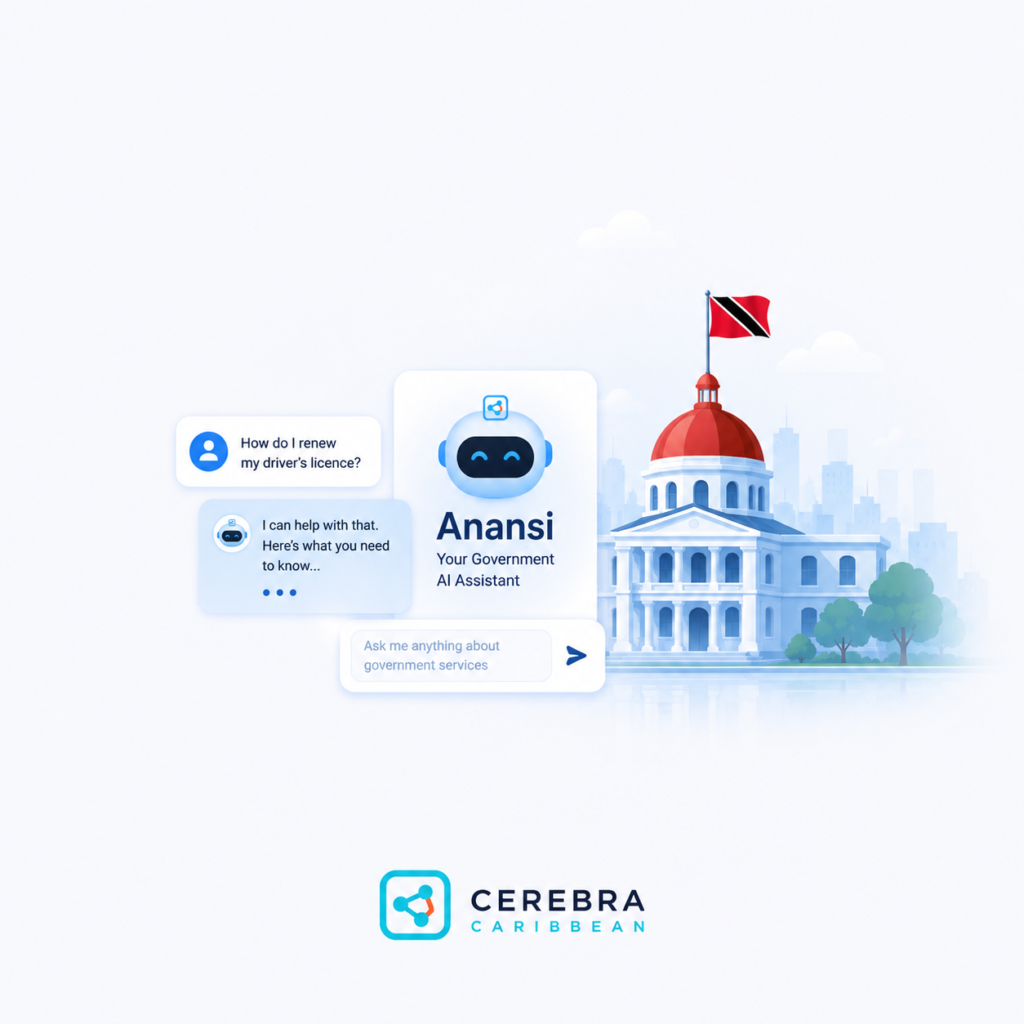
On August 5, 2025, at the Ministry of Public Administration and Artificial Intelligence in Port of Spain, Trinidad and Tobago introduced Anansi — a national, government-wide artificial intelligence assistant designed to answer citizens’ questions about public services in plain, conversational language. Named for the trickster-spider of West African and Caribbean folklore, celebrated as the keeper of all stories, Anansi is intended to gather the scattered knowledge of dozens of government ministries, departments, and agencies into a single, searchable, conversational point of contact. For Caribbean businesses watching the region’s public sector move first into large-scale AI deployment, Anansi is worth studying closely — not as a government curiosity, but as a live demonstration of what a serious, whole-of-organization AI customer service rollout actually requires.
The Problem Anansi Was Built to Solve
The case for Anansi rested on a plainly stated customer experience failure. A national survey cited at the project’s launch found that 45 percent of citizens described government websites as confusing, and 30 percent reported long wait times for responses — numbers that would alarm any private-sector customer service leader, let alone a government responsible for services that citizens cannot simply take their business elsewhere to obtain. Long lines, conflicting information across agencies, and confusing application processes had become, in the words of local reporting on the launch, synonymous with public service in Trinidad and Tobago.
Dr. Inshan Meahjohn, CEO of iGovTT — the National Information and Communication Technology Company that built and operates Anansi — framed the project’s purpose in terms that any customer-facing business would recognize immediately: freeing skilled staff from repetitive, low-value queries so they can focus where their judgment actually matters. At the launch, he described the goal as creating a seamless partnership where AI handles the high-volume, repetitive tasks — ‘what are your opening hours’ type queries — so that human experts are freed to focus on the complex, high-empathy situations that require real judgment and understanding. He was careful to frame this as augmentation rather than displacement, telling the gathering plainly that the initiative was not about a future where machines replace dedicated public servants, but one where technology helps them do their jobs better.
Consolidation as the Core Innovation
What distinguishes Anansi from a typical government chatbot isn’t primarily the AI itself — it’s the scale of consolidation behind it. Rather than each ministry, department, or agency maintaining its own separate chatbot or FAQ page, Anansi was built to connect the knowledge of government into one unified system. At launch, the assistant drew on an index of more than 7,000 frequently asked questions spanning 32 government ministries, departments, and agencies; by the time iGovTT presented on the project at the CANTO 2026 regional technology conference roughly a year later, that footprint had grown to cover 113 ministries, divisions, and state agencies — a substantial expansion in scope within twelve months of launch.
That consolidation directly addresses the citizen confusion the project was built to solve. As iGovTT Chairman Ria Karim explained at CANTO 2026, Anansi allows citizens to ask questions about government information and services in ordinary, natural language, without needing to first figure out which specific ministry or agency holds the answer.
For any Caribbean business operating multiple departments, product lines, or service touchpoints, this is the most transferable lesson in Anansi’s design. Customers do not experience an organization the way an org chart describes it. They experience a single relationship, and they expect a single point of contact to have visibility across the whole thing. A business AI assistant built department by department, in isolated silos, recreates exactly the fragmentation problem that drove citizens to complain about government websites in the first place. Anansi’s architecture — one conversational layer sitting on top of a unified knowledge base — is the more durable model.
Built for Universal Accessibility, Not Just Convenience
Minister of Public Administration and Artificial Intelligence Dominic Smith was explicit at launch that Anansi’s purpose extended beyond efficiency into equity of access. He described envisioning a Trinidad and Tobago where a mother could renew her driver’s licence on her lunch break, and a small business owner could obtain a permit without taking a day off from work.
Edson Eastmond, head of TTconnect, situated Anansi as a natural evolution of work the government had already been doing for years through TTconnect and individual agency chatbots, rather than a system built from nothing. Anansi brings genuine artificial intelligence to bear — built for speed and for 24/7 availability — while the human TTconnect team remains the layer responsible for judgment, nuance, and cases the AI shouldn’t attempt to resolve alone.
That ‘AI plus human intelligence’ framing is worth taking seriously as a design principle. When Anansi reaches the point where a citizen needs something beyond what the AI can appropriately provide, the interaction moves to a trained TTconnect officer, and if that happens outside operating hours, the matter is captured for follow-up rather than left unresolved.
Why a Government Moved First
It is worth pausing on the fact that a government agency, not a private company, is the entity setting the regional pace on large-scale conversational AI deployment. Governments are rarely early adopters of citizen-facing technology; the institutional incentives that typically drive rapid private-sector innovation simply don’t apply to a passport office in the same way they apply to a bank or a telecom.
That Trinidad and Tobago’s public administration ministry chose to move anyway, and to do so at national scale rather than through a narrow pilot, signals something about how urgent the underlying customer experience problem had become — and about where public expectations are heading.
For Caribbean businesses, that sequencing carries a warning as much as an opportunity. When a national government has built and scaled a sophisticated, AI-plus-human conversational system covering 113 agencies within a year, the baseline expectation for good customer service in that market has shifted. Citizens who get fast, natural-language answers from a government ministry will not extend much patience to a private business that still routes them through a rigid phone tree or an unstaffed contact form.
What Caribbean Businesses Should Take From Anansi
Consolidate before you automate. Anansi’s power comes from unifying a fragmented knowledge base into one system, not merely from the AI layer itself. A business considering AI customer service should audit how scattered its own institutional knowledge is before investing in a conversational front end.
Design the escalation path as carefully as the automation. iGovTT built a specific mechanism for handing a citizen off to a human officer, including a process for capturing after-hours cases rather than losing them.
Frame AI as augmentation, publicly and repeatedly. Every official quoted at Anansi’s launch and its subsequent public appearances returned to the same message: this is not about replacing people. Private businesses rolling out AI customer service face the same trust gap with staff and customers.
Expect scope to grow fast once the foundation is right. Anansi’s expansion from 32 to 113 participating government bodies within roughly a year suggests that once a unified knowledge architecture and working AI-human handoff model are in place, scaling coverage becomes far easier than building the initial foundation.
What Anansi Means for AI Adoption in Trinidad & Tobago
Anansi is a useful local proof point for a broader shift: conversational AI is no longer something Trinidad and Tobago businesses need to evaluate only through overseas case studies. The architecture being demonstrated locally — unified knowledge, natural-language access, 24/7 first response and deliberate human escalation — maps directly to customer-service challenges in retail, automotive, distribution, hospitality, healthcare and professional services.
For businesses considering the same model, Cerebra focuses on applying these principles across the channels Caribbean customers already use, including WhatsApp, social messaging and voice.
See how the same AI-plus-human model can work in your business.
Book a Cerebra AI agent demo → and we can map your most repetitive customer enquiries, knowledge sources and human handoff points.